
Demilec Attic Insulation in Enterprise: A Homeowner’s Guide
Most homeowners who get quoted “Demilec” assume they’re comparing one product against another brand. In reality, Demilec makes two spray foams that behave so differently in an Enterprise attic that they may as well be different materials. One is closed-cell Heatlok HFO, the other is open-cell Sealection 500, and picking the wrong one for your roof assembly can mean spending more than you needed to or getting less performance than you paid for. This guide walks through what each one does, when it makes sense, and the questions to ask before you sign anything.
What’s the difference between Heatlok HFO and Sealection 500?
Helatok HFO is Demilec’s closed-cell spray foam, and Sealection 500 is their open-cell product. Closed-cell foam cures into a dense, rigid material with a higher R-value per inch and its own built-in vapor barrier. Open-cell foam cures lighter and spongier, insulates less per inch, and stays vapor-permeable. In Enterprise’s hot, dry climate, that vapor difference matters more than homeowners expect.
Here’s how the two stack up:
- Helatok HFO (closed-cell): Roughly twice the R-value per inch of open-cell, high density, acts as a vapor retarder, adds structural rigidity to the roof deck. Uses a fourth-generation blowing agent with low global warming potential.
- Sealection 500 (open-cell): Lower R-value per inch, vapor-permeable, softer feel, better for sound absorption. Costs less per board foot, but needs more thickness to reach the same R-value.
Neither is “better.” They’re engineered for different jobs. The trick is matching the product to your attic assembly, not to whatever the installer has stacked in the truck.
Why does closed-cell Demilec often make sense for Enterprise attics?
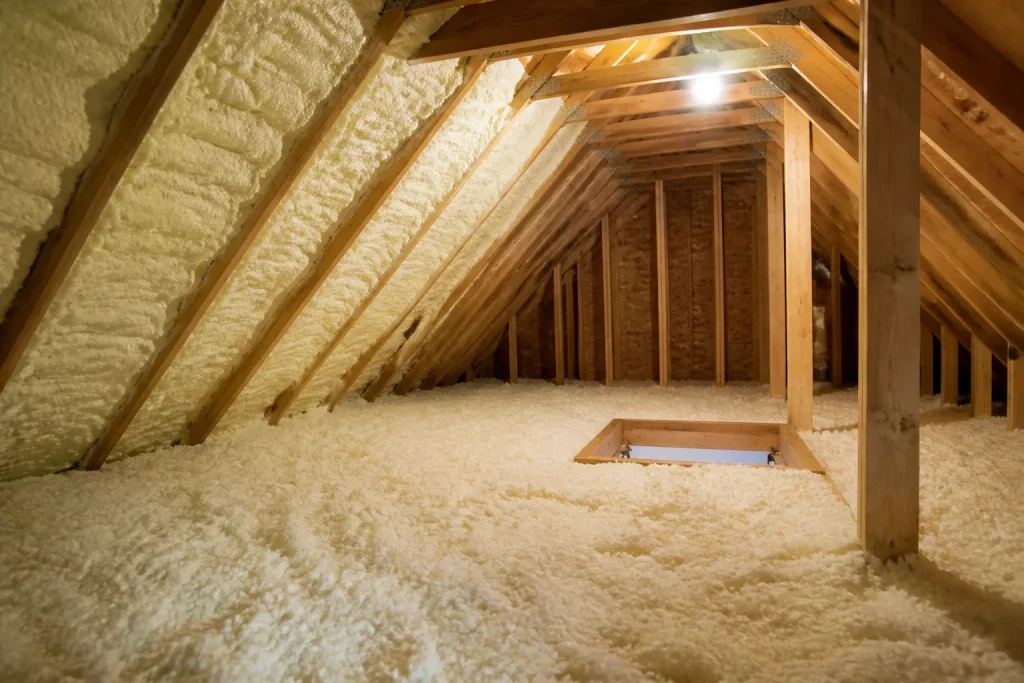
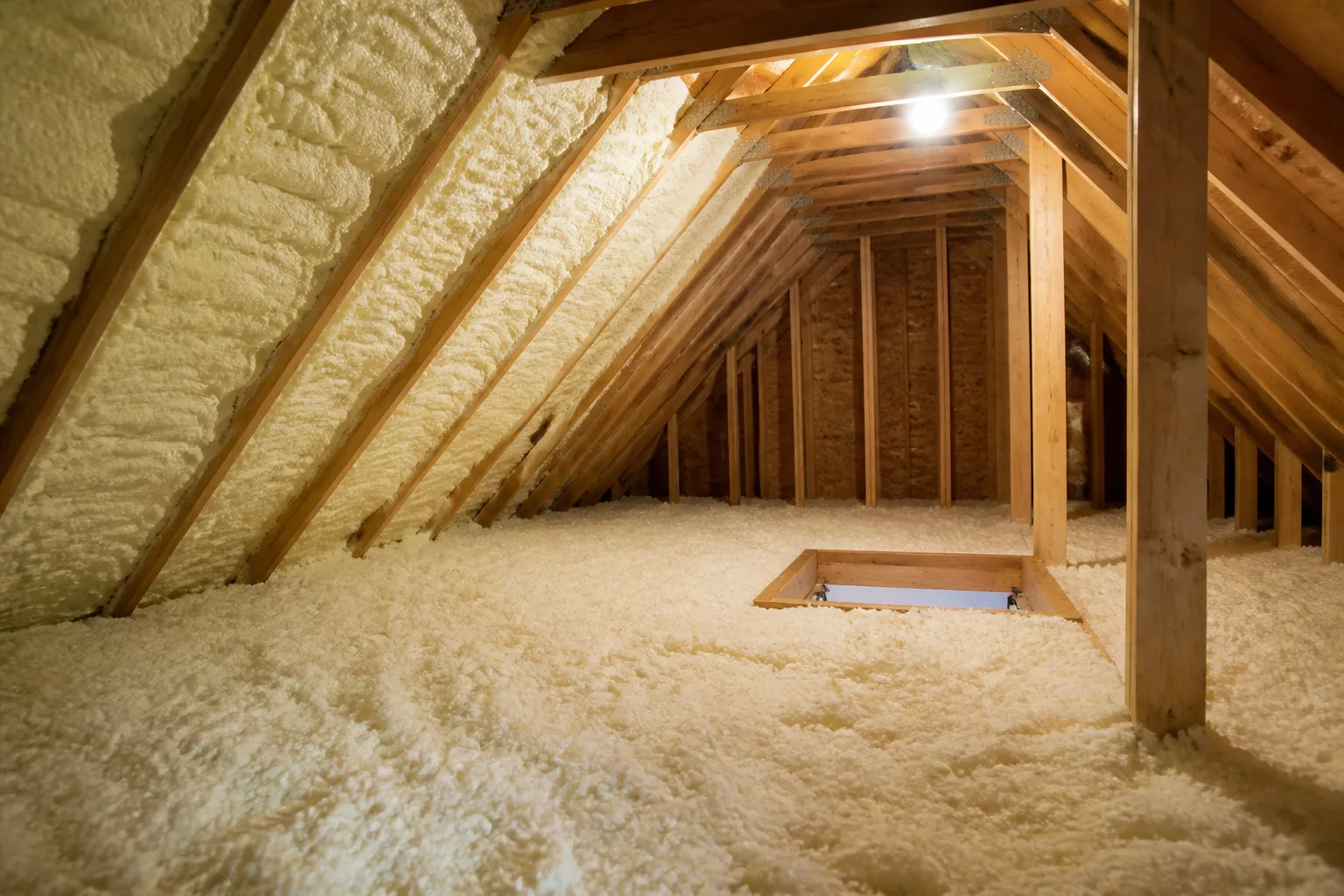
Enterprise sits in a hot-dry desert climate. Attics here regularly bake through triple-digit summers, and the roof deck gets the worst of it. Many homeowners in Enterprise end up converting a vented attic into an unvented, cathedralized assembly, which means the insulation goes directly against the underside of the roof deck instead of the attic floor. That’s where closed-cell Heatlok HFO earns its keep.
Three reasons stand out:
- Vapor control. An unvented roof deck in a hot climate can drive moisture into the assembly if you’re not careful. Closed-cell foam’s low permeability helps manage that, while keeping the deck dry in the direction that matters.
- R-value per inch. Cathedralized ceilings constrain how much thickness you can fit. Closed-cell foam packs more thermal resistance into the same cavity, so you don’t lose ceiling height.
- Air sealing. Spray foam seals and insulates in one step. On a roof deck that’s been leaking conditioned air into the attic for years, that single step fixes both problems at once.
Open-cell Sealection 500 can still be the right call in a vented attic where the insulation stays on the floor and venting stays intact. It’s also a reasonable option when budget is tight and there’s room for extra thickness. We’ve seen both products work well in Enterprise when they’re specified for the right assembly – and we’ve seen both fail when they’re swapped.
What does “low-GWP blowing agent” actually mean for Heatlok HFO?
Heatlok HFO uses a hydrofluoroolefin blowing agent, which is a fourth-generation chemistry with a much lower global warming potential than the HFCs used in older closed-cell foams. In plain terms, the gas trapped inside the cured foam has far less climate impact if it ever escapes. That’s the whole point of the “HFO” in the name.
Why it’s become a talking point in Enterprise:
- Homeowners comparing quotes increasingly ask about the environmental profile of spray foam, and Heatlok HFO answers that with a lower-impact gas.
- It performs the same as conventional closed-cell in thermal and vapor terms, so there’s no trade-off in the attic itself.
- It signals a manufacturer that’s investing in current chemistry rather than the older formulation.
If you’re weighing Demilec against Icynene or another closed-cell product, ask specifically which blowing agent is being used. It’s a fair question, and a good installer will have a straight answer.
Can you spray Demilec foam over existing insulation?
Sometimes. Usually not without a look first. Spray foam adheres to whatever it’s sprayed against, so laying closed-cell Heatlok HFO over a bed of old, compressed fiberglass on the attic floor is a waste of money – you’d be sealing to a surface that isn’t clean or structurally sound. The foam needs a solid, dry, debris-free substrate to bond to.
In our experience on Enterprise retrofits, the decision usually breaks down like this:
- Remove first: old fiberglass that’s been compressed, contaminated, wet, or is harboring rodent activity. Foam over that traps the problem in place.
- Layer over is fine: when the existing insulation is clean, dry, and in good structural condition, and the new foam is being applied to the roof deck rather than the attic floor – the two systems don’t compete for the same space.
- Air-seal first, insulate second: penetrations, top plates, and gaps get sealed before any new insulation goes in, whether that’s foam or a blown-in product like GreenFiber cellulose or Rockwool mineral wool.
Skipping the removal step to save on disposal costs is one of the most common retrofit mistakes we see. The savings usually don’t hold.
What should you ask an installer quoting Demilec?
Getting a Demilec quote is easy. Getting a Demilec quote that specifies the right product at the right thickness for your attic is the part that takes a few pointed questions. Here’s a short list worth having in hand:
- Is this Heatlok HFO or Sealection 500, and why? The answer should connect to your attic assembly – vented vs. unvented – not to what’s in stock.
- What R-value is being targeted, and at what thickness? Ask for both the R-value per inch and the finished thickness so you can check the math yourself.
- How will the existing insulation be handled? Remove, encapsulate, or layer – get a clear answer.
- Will the attic be tested or inspected before and after? A moisture reading before spraying prevents surprises.
- Is the crew trained on Demilec’s spec sheets? Demilec publishes application guidance for each product, and a competent installer should be able to walk you through it.
You don’t need to be a foam chemist. You just need to ask enough to know whether you’re getting a thoughtful specification or a number on a page.
When to call a pro
Spray foam is not a DIY product. The chemicals require proper handling, the equipment is specialized, and a mis-specified application in an unvented roof assembly can trap moisture in ways that take years to surface. If your attic has active moisture issues, rodent contamination, or a roof deck that’s been leaking, get it looked at before anyone sprays. That’s the moment to call a specialist who works on insulation every day, not a generalist who happens to offer it.
Related services in Enterprise: we install attic insulation, spray foam insulation, and blown-in insulation across the Enterprise area, using products from Owens Corning, Johns Manville, Knauf, Rockwool, CertainTeed, Icynene, Demilec, and GreenFiber. If you’d rather weigh your options with someone who’s looked at a lot of attics, our team at Attic Insulation Enterprise is glad to talk it through.
The Bottom Line
Demilec is not a single product. Heatlok HFO and Sealection 500 are engineered for different applications, and in Enterprise’s hot-dry climate the closed-cell formulation is often the correct choice for an unvented attic assembly, while open-cell can work in a vented attic with room for thickness. Whichever route you take, the specification matters more than the brand name on the drum. Ask what’s being used, why, and at what thickness. That’s how you avoid paying for the wrong foam.
If you’re in Enterprise and want a straight read on which spray foam makes sense for your attic, our technicians have up to 9 years of experience with both open-cell and closed-cell products, and estimates are free. Call (877) 702-6273. We answer 24/7, with fast dispatch from 7am to 7pm, Sunday through Friday. A written quote follows the walk-through, and that written quote sets the final price.
Frequently Asked Questions
It depends on the assembly. Closed-cell Demilec (Heatlok HFO) is often the stronger choice for unvented roof decks in Enterprise’s climate because it air-seals and insulates in one step and manages vapor. Fiberglass batts and blown-in products remain a good fit for vented attics where budget or existing structure favors them. Call (877) 702-6273 for an exact recommendation – estimates are free.
Pricing depends on square footage, attic geometry, whether old insulation needs removal, and which Demilec product is specified. Closed-cell Heatlok HFO typically costs more than open-cell Sealection 500 per board foot because of density and material. A written estimate is the only reliable figure. Call (877) 702-6273 to schedule a free estimate.
Sometimes, but not usually without inspection. Foam needs a clean, dry, solid substrate, so old compressed or contaminated fiberglass typically has to come out first. In retrofit work, layering over existing insulation is only safe when the old material is in good condition and the new foam isn’t competing for the same cavity. Call (877) 702-6273 to talk through your attic.
A typical attic takes a few hours to a couple of days depending on square footage, roof complexity, and whether old material needs removal first. The estimate visit sets the timeline. Call (877) 702-6273 for a free estimate – we’ll give you a clear window before you commit.
Written by the team at Attic Insulation Enterprise.
Need Insulation Help?
Call Attic Insulation Enterprise - licensed & insured, here with fast help in Enterprise.
(877) 702-6273